


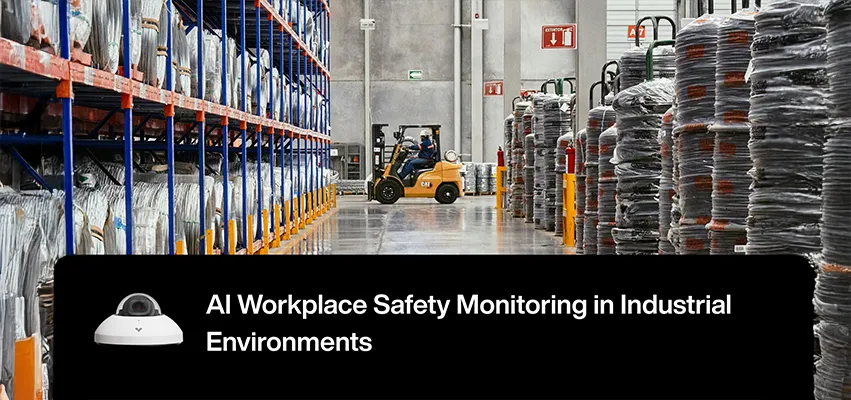
Industrial environments move fast. Forklifts, machinery, loading zones, and active production floors all create conditions where safety risks can escalate quickly. In many facilities, safety teams still rely on traditional video footage after an incident happens, using it to review events, document what occurred, and determine next steps.
Today, AI-powered workplace safety tools are helping organizations move beyond that reactive model.
With the right physical security platform, safety and operations teams can improve visibility into workplace activity, detect risky behaviour earlier, and support faster intervention before small issues become larger incidents. Verkada’s workplace safety capabilities highlight detections for unsafe forklift operation, including operators using phones, as well as support for PPE compliance and broader visibility into safety risks across industrial environments.
Why AI is changing workplace safety
For years, video security has mainly been used as a review tool. When an incident takes place, someone has to go back through footage, search for the right moment, and piece together what happened. That approach takes time and often limits how quickly teams can respond.
AI helps shift that process forward.
Instead of only supporting post-incident investigation, AI can help identify risky activity earlier and surface relevant events faster. In industrial and manufacturing settings, that means safety teams can improve awareness of unsafe behaviour, strengthen compliance efforts, and act sooner when risk is detected.
This shift is important because workplace safety is not only about reviewing incidents after the fact. It is also about prevention, consistency, response speed, and building safer day-to-day operations.
How AI supports safer forklift operations
Forklift activity remains one of the most common sources of risk in warehouses, plants, and industrial facilities. Limited visibility, distracted driving, pedestrian traffic, and inconsistent adherence to safety procedures can all contribute to accidents or near misses.
AI-powered monitoring helps organizations improve visibility into these environments.
Verkada’s workplace safety capabilities specifically reference unsafe forklift operation and risky behaviours such as operators using phones. This gives safety teams a stronger way to identify concerning patterns, review events faster, and intervene before unsafe habits lead to incidents.
For organizations, this can support practical outcomes such as earlier identification of unsafe driving behaviour, better documentation of near misses, stronger safety coaching, and improved oversight across large or multi-zone facilities.
Rather than relying only on manual supervision or post-incident footage review, teams can use AI to support more proactive safety operations.
PPE compliance and workplace visibility
Personal protective equipment remains one of the most important requirements in industrial safety. But maintaining consistent PPE compliance across shifts, teams, and larger facilities can be difficult when monitoring depends entirely on manual observation.
This is another area where AI adds operational value.
Verkada’s workplace safety materials highlight support for PPE compliance and broader visibility into workplace activity. That helps organizations strengthen awareness around whether required protective measures are being followed and whether additional intervention may be needed in certain zones or workflows.
AI does not replace safety leadership or human judgment. It gives teams better visibility, faster context, and a stronger ability to support compliance at scale.
From reactive review to proactive response
One of the most important benefits of AI in physical security is speed.
When safety teams can identify potentially unsafe behaviour earlier, review footage more efficiently, and respond faster to risk, the entire workplace safety strategy becomes stronger. Instead of waiting until after an incident to understand what happened, organizations can start building a more proactive model focused on monitoring, intervention, and prevention.
In industrial settings, that can improve coordination between safety, operations, facilities, and security teams while creating better visibility into how the workplace is functioning day to day.
Why integrated system design matters
Technology alone does not create a safer workplace. Real value comes from how the system is designed, deployed, and aligned with the realities of the environment.
That includes how cameras are positioned, which behaviours or risks are prioritized, how alerts are configured, and how teams across the organization use the platform in practice.
At GAV MGMT, we help organizations design and deploy integrated security environments that turn advanced AI tools into practical, real-world operational value. The goal is not simply to add more technology. It is to create a system that supports safer workflows, stronger visibility, and more effective decision-making across the facility.
AI workplace safety as an operational advantage
AI can do far more than help investigate incidents after they happen.
In industrial environments, it can help teams spot risky behaviour earlier, support PPE compliance, improve visibility into daily operations, and respond faster when something needs attention. For organizations managing active facilities, forklift traffic, and complex safety requirements, that can make a measurable difference.
When physical security becomes more intelligent, it also becomes more useful to the broader operation.
That is where workplace safety technology starts delivering value not just as a monitoring tool, but as an operational advantage.
Written by Gianfranco, Digital Marketing Manager at GAV MGMT