


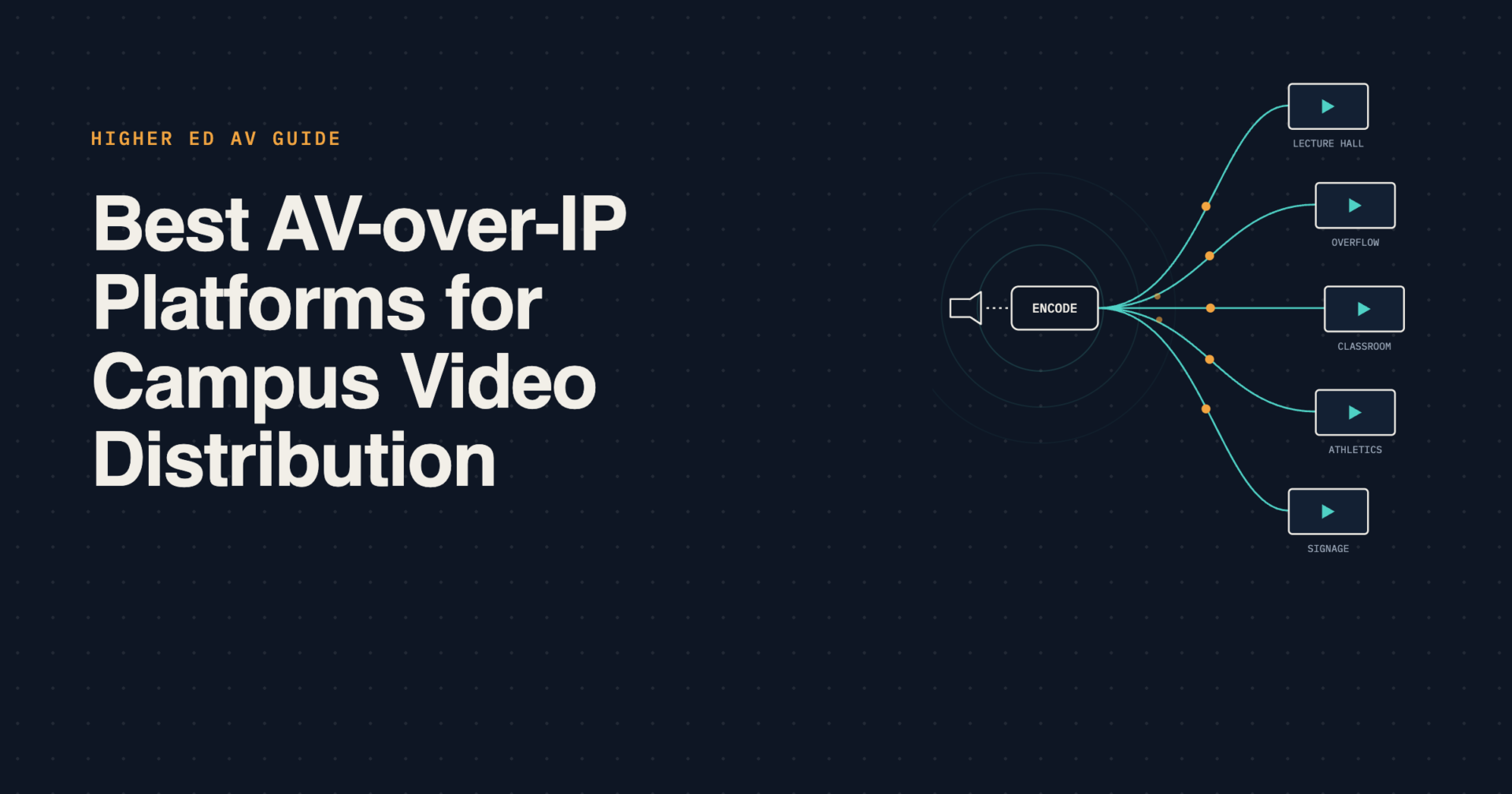
The best AV-over-IP platform for a campus is the one that matches your network architecture, your control ecosystem, and the rooms you need to serve. For most higher education environments, the leading options are Crestron DM NVX, Q-SYS NV Series, Extron NAV, AMX SVSI by HARMAN, and SDVoE-based systems, with IPMX emerging as an open-standard path. Each fits a different combination of bandwidth, latency, scale, and management needs.
This guide breaks down how to evaluate AV-over-IP solutions for campus-wide video distribution, where each platform fits, and what enterprise AV and IT teams should align on before deployment.
What Is AV-over-IP?
AV-over-IP is the distribution of audio, video, and control signals over a standard Ethernet network instead of dedicated point-to-point cabling or matrix switchers. Encoders convert sources such as PCs, cameras, and media players into network streams, and decoders deliver those streams to displays, projectors, and recorders anywhere on the network.
For campuses, networked audio video means any source can reach any endpoint, rooms can be added without replacing a central switcher, and AV infrastructure can be managed with the same tools and practices IT already uses.
How to Choose an AV-over-IP Platform for Higher Education
Start with use cases and infrastructure, then narrow to platforms. These seven criteria shape nearly every campus decision.
1. Network class: 1GbE or 10GbE. Most campus networks are built on 1GbE to the edge. Platforms designed for 1GbE use visually lossless compression to deliver 4K over existing infrastructure. 10GbE platforms use lighter compression for near-zero latency and require higher-capacity switching.
2. Latency and image fidelity. Active learning classrooms, interactive whiteboards, and camera-to-display workflows benefit from low-latency codecs. Campus-wide broadcast, overflow seating, and signage can use higher-compression streams such as H.264 or H.265 for efficient distribution.
3. Scale and multicast design. Campus-wide video distribution relies on multicast and IGMP snooping to deliver one stream to many endpoints efficiently. Confirm how each platform handles stream counts, switch requirements, and routing across VLANs and buildings.
4. Control and ecosystem fit. The platform should align with your standard control system, room scheduling, and user interface. Consistency across buildings simplifies support, training, and user experience.
5. Audio integration. Look for native support for Dante and AES67 so video endpoints integrate cleanly with your networked audio, DSPs, and microphones.
6. Security and management. IT teams will look for 802.1X authentication, encrypted streams, HDCP handling, centralized device management, and firmware update workflows at scale.
7. Standards and interoperability. Proprietary platforms offer tightly integrated ecosystems. Standards-based approaches such as SDVoE and IPMX offer multi-vendor flexibility. Many campuses run a mix, matched to room types.
Leading AV-over-IP Platforms Compared
| Platform | Network | Best-fit campus use case | Ecosystem strength |
| Crestron DM NVX | 1GbE | Standardized classrooms and lecture halls on Crestron control | Tight integration with Crestron control, XiO Cloud, and DM NVX Director |
| Q-SYS NV Series | 1GbE | Campuses standardizing on Q-SYS for audio, video, and control | Unified software-based platform in Q-SYS Designer |
| Extron NAV | 1GbE | Large-scale deployments on Extron control and switching | NAVigator system management and Extron control ecosystem |
| AMX SVSI by HARMAN | 1GbE and streaming options | Mixed low-latency and streaming distribution | Range of encoder and decoder families for varied workflows |
| SDVoE-based systems | 10GbE | Low-latency, high-fidelity spaces and multi-vendor environments | Interoperable ecosystem across multiple manufacturers |
| IPMX-based systems | Varies | Future-ready, standards-driven deployments | Open standard building on SMPTE ST 2110 |
Crestron DM NVX
DM NVX is a strong fit for campuses that already use Crestron control across classrooms and meeting spaces. It delivers 4K video over 1GbE networks and supports Dante and AES67 audio on many models. DM NVX Director centralizes routing and management for large deployments, and XiO Cloud supports remote monitoring across buildings.
Best fit when: your campus standard is Crestron control and you want a consistent AV-over-IP layer across classrooms, lecture halls, and event spaces.
Q-SYS NV Series
Q-SYS brings video into the same software-based platform that manages audio and control. NV Series endpoints are configured in Q-SYS Designer alongside DSP, cameras, and user interfaces, giving AV teams a single environment to design, deploy, and support.
Best fit when: your campus uses Q-SYS for audio and control and wants video in the same ecosystem, particularly for lecture capture and hybrid learning rooms.
Extron NAV
Extron NAV distributes 4K video over 1GbE and uses the NAVigator system manager for configuration, routing, and monitoring. It pairs naturally with Extron control processors, switchers, and room systems common in higher education.
Best fit when: your campus standards are built around Extron and you are scaling to large endpoint counts.
AMX SVSI by HARMAN
The SVSI line includes encoder and decoder families designed for different workflows, from low-latency room distribution to streaming for wider distribution. This range makes it a flexible option when one campus needs several distribution models.
Best fit when: you need a mix of in-room and broadcast-style distribution within one product family.
SDVoE-Based Systems
SDVoE is an ecosystem of interoperable products from multiple manufacturers built on 10GbE. The lighter compression supports very low latency and high image fidelity, which suits interactive spaces and high-detail content.
Best fit when: you have or plan 10GbE switching and want multi-vendor flexibility with low-latency performance.
IPMX-Based Systems
IPMX (Internet Protocol Media Experience) is an open standard for professional AV built on SMPTE ST 2110. It is designed for interoperability across manufacturers and aligns with broadcast-grade workflows increasingly used in campus media production.
Best fit when: long-term interoperability and open standards are a priority in your AV roadmap, especially for media production and broadcast facilities.
Matching AV-over-IP Platforms to Campus Use Cases
The strongest campus deployments assign distribution methods by room type rather than forcing one approach everywhere.
Classrooms and lecture halls: 1GbE low-latency platforms aligned with your control standard deliver consistent user experience and simpler support.
Overflow seating and campus-wide events: Multicast distribution, often with H.264 or H.265 streaming, sends one presentation to many rooms efficiently.
Divisible and multipurpose spaces: AV-over-IP makes room combining a routing change, with no hardware rewiring required.
Digital signage and IPTV: Streaming-based distribution scales to hundreds of screens across buildings with minimal bandwidth per endpoint.
Athletics, media production, and simulation labs: Low-latency 10GbE or standards-based IPMX workflows support high-fidelity, real-time content.
Scalability Tradeoffs to Plan For
Scalable audiovisual systems depend on decisions made at the network layer. Plan for these tradeoffs early.
Bandwidth per stream versus switch capacity. Higher-fidelity streams consume more bandwidth, which shapes switch selection and uplink sizing between buildings.
Centralized versus distributed management. A central management platform simplifies routing and monitoring as endpoint counts grow into the hundreds or thousands.
Single-ecosystem versus multi-vendor. A single ecosystem offers streamlined support and integration. A multi-vendor approach offers flexibility and room-by-room optimization. Both are valid when chosen deliberately.
Growth path. Choose a platform with a clear roadmap for resolution, audio integration, and management so new buildings and renovations extend the same architecture.
Integration Considerations for Enterprise AV and IT Teams
AV-over-IP succeeds when AV and IT teams design it together. Align on these items before deployment.
- Network design: dedicated VLANs, multicast routing, IGMP snooping and querier configuration, and QoS policies
- Switching: confirm manufacturer-qualified switch models and PoE budgets for endpoints
- Security: 802.1X, stream encryption, credential management, and firmware update policies
- Monitoring: integration with existing network monitoring and remote AV management tools
- Standards documentation: room templates, naming conventions, and IP address plans that scale across the campus
- Support model: clear ownership between AV and IT for troubleshooting and change management
Frequently Asked Questions
What is the best AV-over-IP platform for a university?
The best platform is the one that aligns with your campus control standard, network infrastructure, and room types. Crestron DM NVX, Q-SYS NV Series, and Extron NAV are common choices for 1GbE campus networks, while SDVoE suits 10GbE low-latency environments.
Can AV-over-IP run on an existing campus network?
Yes. Most 1GbE AV-over-IP platforms are designed for standard enterprise networks, provided switches support the required multicast and IGMP features. Many campuses place AV traffic on dedicated VLANs or a separate physical network for performance and management.
What is the difference between 1GbE and 10GbE AV-over-IP?
1GbE platforms use visually lossless compression to deliver 4K over common infrastructure. 10GbE platforms use lighter compression for lower latency and require higher-capacity switching.
How does AV-over-IP support campus-wide video distribution?
Multicast networking lets one encoder stream reach many decoders at once, so lectures, events, and announcements can be distributed to any room, building, or display on the network.
Is IPMX ready for campus deployments?
IPMX is an emerging open standard gaining manufacturer adoption. It is well suited to campuses planning media production facilities or prioritizing long-term interoperability.
Design Your Campus AV-over-IP Strategy with GAV MGMT
GAV MGMT designs and integrates enterprise AV infrastructure for higher education and campus environments, with a multi-vendor portfolio that lets us match each platform to the rooms and workflows it serves best. Visit our Experience Centre at First Canadian Place in Toronto to see networked audio video solutions in action, or connect with our team to plan your campus video distribution strategy.
Written by Gianfranco, Digital Marketing Manager at GAV MGMT