


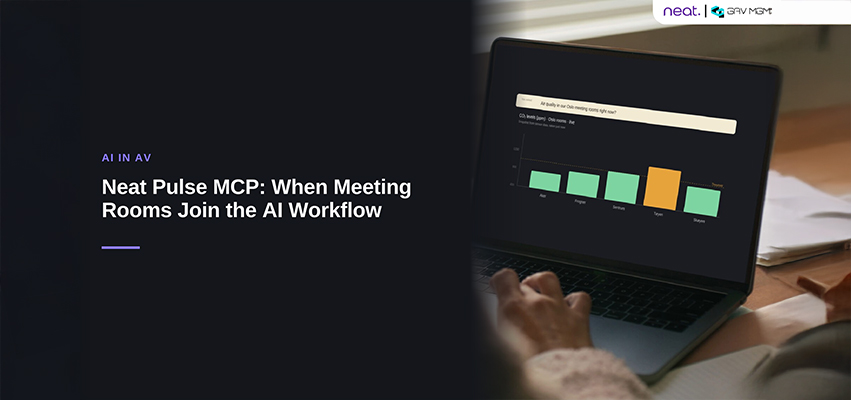
Les salles de réunion ont toujours été légèrement à l’écart du reste des flux de travail TI d’une organisation. Les courriels, les tableaux de projets et les systèmes CRM sont connectés aux outils d’IA depuis un certain temps déjà. Ce n’était pas le cas des salles, principalement parce qu’il n’existait pas de moyen standard de donner à un agent d’IA accès à ce qui s’y passe. À l’InfoComm 2026, Neat a présenté Neat Pulse MCP, une intégration qui comble cette lacune grâce au Model Context Protocol, la norme ouverte qui permet aux agents d’IA de se connecter directement aux outils et aux plateformes qu’une organisation utilise déjà.
Ce que le Model Context Protocol change
MCP permet aux agents d’IA de récupérer de l’information, d’effectuer des actions et de coordonner des flux de travail entre les systèmes connectés. Neat a clairement indiqué que Pulse MCP n’est ni une couche d’IA propriétaire ni un assistant propre à Neat. Il s’agit d’une norme ouverte appliquée à l’infrastructure des salles de réunion, ce qui signifie qu’elle peut fonctionner avec les outils et les modèles d’IA qu’une organisation utilise déjà, notamment Claude.
En pratique, cela signifie qu’une équipe TI n’a plus besoin d’ouvrir le tableau de bord Neat Pulse pour vérifier l’état des salles, configurer de nouveaux espaces ou effectuer une vérification de l’état des appareils. Elle peut simplement poser une question en langage courant, et l’agent s’en charge en utilisant les mêmes données et actions que celles déjà offertes par Neat Pulse.
Ce qu’il peut faire aujourd’hui
Neat Pulse MCP est maintenant disponible sous forme de version bêta hébergée localement, et sa configuration prend environ dix minutes. En version bêta, il prend en charge :
- L’affichage et la gestion des appareils, notamment le redémarrage du matériel à distance
- La création et la configuration de nouvelles salles
- La génération de codes d’inscription pour le nouveau matériel
- L’interrogation des données sur les salles, les emplacements et les capteurs
- L’envoi de messages directement à l’écran d’une salle
Comme la version bêta fonctionne localement, elle est compatible avec des clients MCP locaux comme Claude Code et Gemini CLI.
À quoi cela ressemble en pratique
Un administrateur qui gère des salles dans plusieurs bureaux pourrait demander si toutes les salles d’un ensemble d’emplacements sont prêtes avant une réunion à l’échelle de l’entreprise. L’agent vérifie l’état des appareils, la connectivité et les données des capteurs dans ces emplacements, résout de façon autonome ce qu’il peut et signale tout élément qui nécessite encore une intervention. La même approche peut être appliquée à la configuration d’un nouveau bureau : un administrateur peut décrire les salles nécessaires et le profil de configuration à appliquer, puis l’agent les crée avec les codes d’inscription prêts avant même l’arrivée du matériel.
Cela ouvre également la voie à des flux de travail permanents, comme une vérification quotidienne de l’état des appareils qui génère automatiquement un rapport, sans que personne ait à ouvrir un tableau de bord au préalable.
Une évolution plus importante
Neat se positionne parmi les premières entreprises du secteur à intégrer une gestion basée sur MCP aux salles de réunion. L’importance de cette innovation tient moins à une fonctionnalité particulière qu’à ce qu’elle annonce : les salles de réunion commencent à fonctionner comme des systèmes connectés au sein des flux de travail d’IA plus larges d’une organisation, plutôt que comme du matériel isolé que les équipes TI doivent vérifier séparément. Pour les organisations qui gèrent des salles dans plusieurs emplacements, il s’agit d’une évolution importante qui pourrait réduire considérablement la surveillance manuelle nécessaire pour gérer un parc de salles.
Foire aux questions
Qu’est-ce que Neat Pulse MCP?
Neat Pulse MCP est une intégration basée sur le Model Context Protocol qui connecte directement la plateforme de gestion des appareils de Neat, Neat Pulse, à des agents d’IA comme Claude. Elle donne à un agent d’IA accès aux mêmes données et actions liées aux salles, aux appareils et aux capteurs que celles disponibles dans Neat Pulse, ce qui permet aux équipes TI de gérer les salles de réunion au moyen de demandes en langage courant plutôt que par l’intermédiaire d’un tableau de bord.
Neat Pulse MCP est-il disponible maintenant?
Oui. Il est actuellement offert sous forme de version bêta hébergée localement aux clients de Neat. Comme il fonctionne localement, il est compatible avec des clients MCP locaux comme Claude Code et Gemini CLI. Sa configuration prend environ dix minutes.
Que peut réellement faire Neat Pulse MCP?
En version bêta, il prend en charge l’affichage et la gestion des appareils, le redémarrage du matériel à distance, la création et la configuration de salles, la génération de codes d’inscription, l’interrogation des données sur les salles, les emplacements et les capteurs, ainsi que l’envoi de messages directement à l’écran d’une salle.
Qu’est-ce que le Model Context Protocol (MCP)?
MCP est une norme ouverte qui permet aux agents d’IA, aux assistants et aux flux de travail automatisés de se connecter directement aux outils, aux plateformes et aux services qu’une organisation utilise déjà. Plutôt que de constituer une couche d’IA propriétaire développée par un seul fournisseur, MCP est conçu pour permettre à l’infrastructure des salles de réunion de fonctionner avec les outils et les modèles d’IA sur lesquels une organisation s’appuie déjà.
Neat Pulse MCP est-il un assistant d’IA propre à Neat?
Non. Neat l’a explicitement présenté comme une norme ouverte appliquée à l’infrastructure des salles de réunion, et non comme une couche d’IA propriétaire ou un assistant propre à Neat. Il est conçu pour fonctionner avec les outils et les modèles d’IA qu’une organisation utilise déjà.
Comment cela change-t-il la gestion quotidienne des salles?
Plutôt que d’ouvrir un tableau de bord pour vérifier les salles réparties dans plusieurs bureaux, un administrateur peut poser une question en langage courant, par exemple demander si toutes les salles d’un ensemble d’emplacements sont prêtes avant une réunion. L’agent vérifie alors l’état des appareils, la connectivité et les capteurs, résout ce qu’il peut de façon autonome et signale les éléments qui nécessitent une intervention.
Rédigé par Gianfranco, Directeur marketing numérique chez GAV MGMT